
Rarities
New finds added weekly
You walk through an alcove and find yourself in a dimly-lit small room. The room smells musty, tangy, earthy. On overloaded shelves you see an intriguing assortment of print items. There’s a carved wooden box where you leave the money if anything from this dark room of wonders needs to entwine with your life. The carving on the box is of a snake eating its tail.
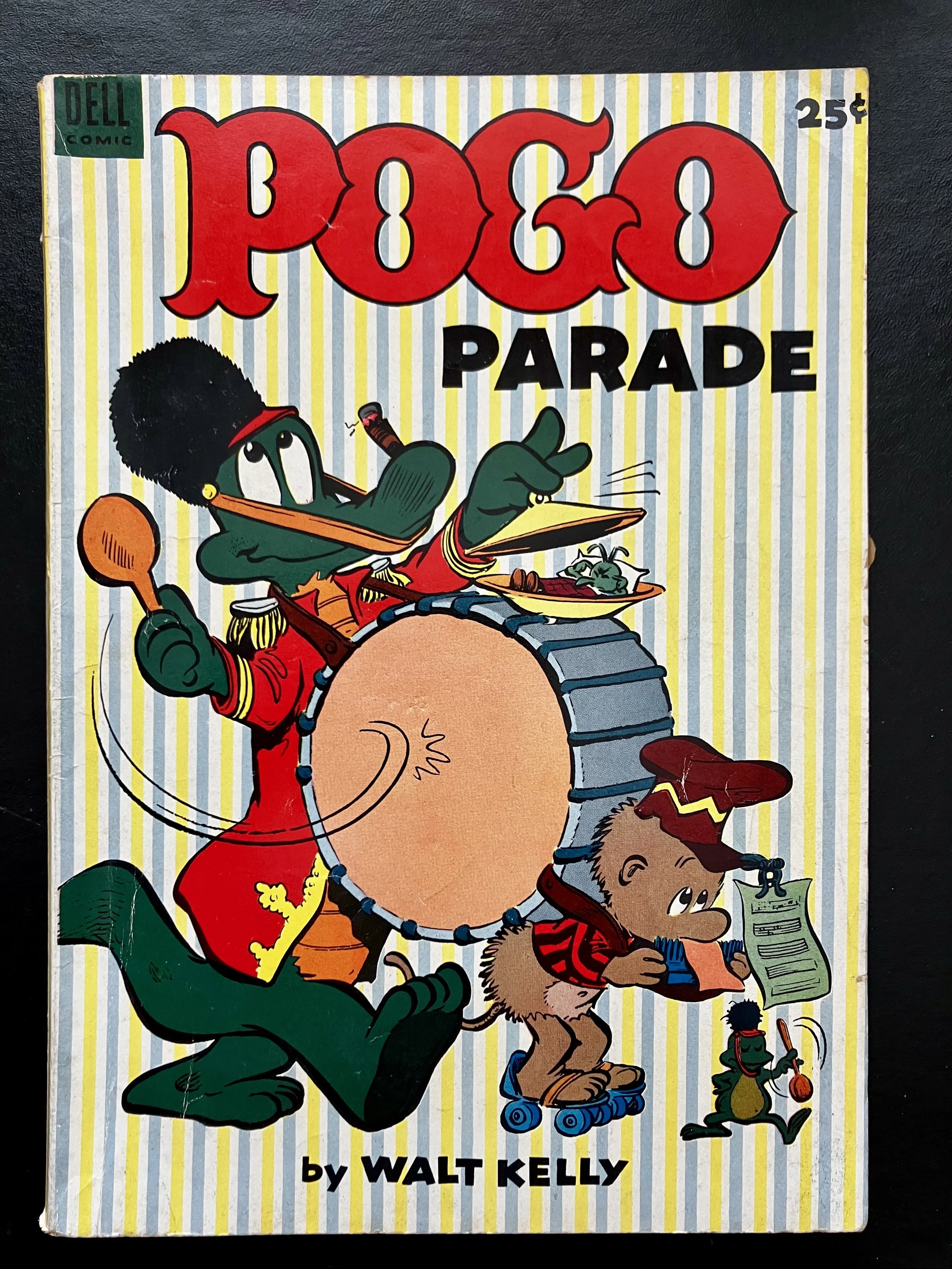
Cover to cover Kelly - 100 pages!
One of the best single issues of a comic book made in mid-20th century America, this 100-page book reprints eleven of the best of Walt Kelly’s Pogo And Albert stories. As Walt puts it in the special introduction on the inside front cover, “… we are reprinting some of the high spots, gullies, and quicksands of Pogo’s comic book career.”
Pogo’s comic book stories are both similar to the newspaper strip and different. For one, they aren’t overtly political. For another, they have a totally different rhythm. And, on the third hand — waitaminnit — well, on the other hand, the comic book stories seem to me to be overall funnier, lighter, and more screwball. The drawing is more relaxed, less fused over, and flows beautifully. Plus, they is a more pronounced Southern dialect which I love, being from Louisiana, myself.
Condition is remarkably good for a comic book that is almost 73 years old. I’m not a professional comics grader, but I’d say this is a strong Good if not VG-. Complete, no markings, binding sound, no tears, minor creasing, slight spine roll. But “collecting” or “investing” is not why I want you to buy this baby. No, I want you to read it and enjoy it, just like I am certain the previous owner(s) did. This copy was unearthed at a flea market in Washington’s Skagit Valley in 2025. The inside back cover reprints four fan letters to Kelly. Truly a labor of love, this beauty!

From when Minecraft was analog - a stunning example of a visual toy assembly instruction manual
Erector sets let kids build things with metal parts, nuts and bolts, and little motors. They had their owns singular look and feel, like little pieces of streamlined steel. These things took a lot of careful observation and thought.
This 1925 manual of instruction come from A.C. Gilbert’s set number four, which had 235 parts that let you build 500 models! The manual is sixty pages long, showing finished assemblies. The artist (s) had to make sure every drawing was precisely accurate so the models could be built that way in real life. Every screw had to be shown in the correct position. There’s something kind of beautiful about these pages, with their dreamlike parade of bridges, wagons, velocipedes, cranes, railroad cars, and even a buzzsaw (see photo).
The cover is loose and in two parts. Interior pages show age and wear but are supple, with binding solid.
There is a terrifically informative illustrated Erector Set Guidebook in PDF form available here.
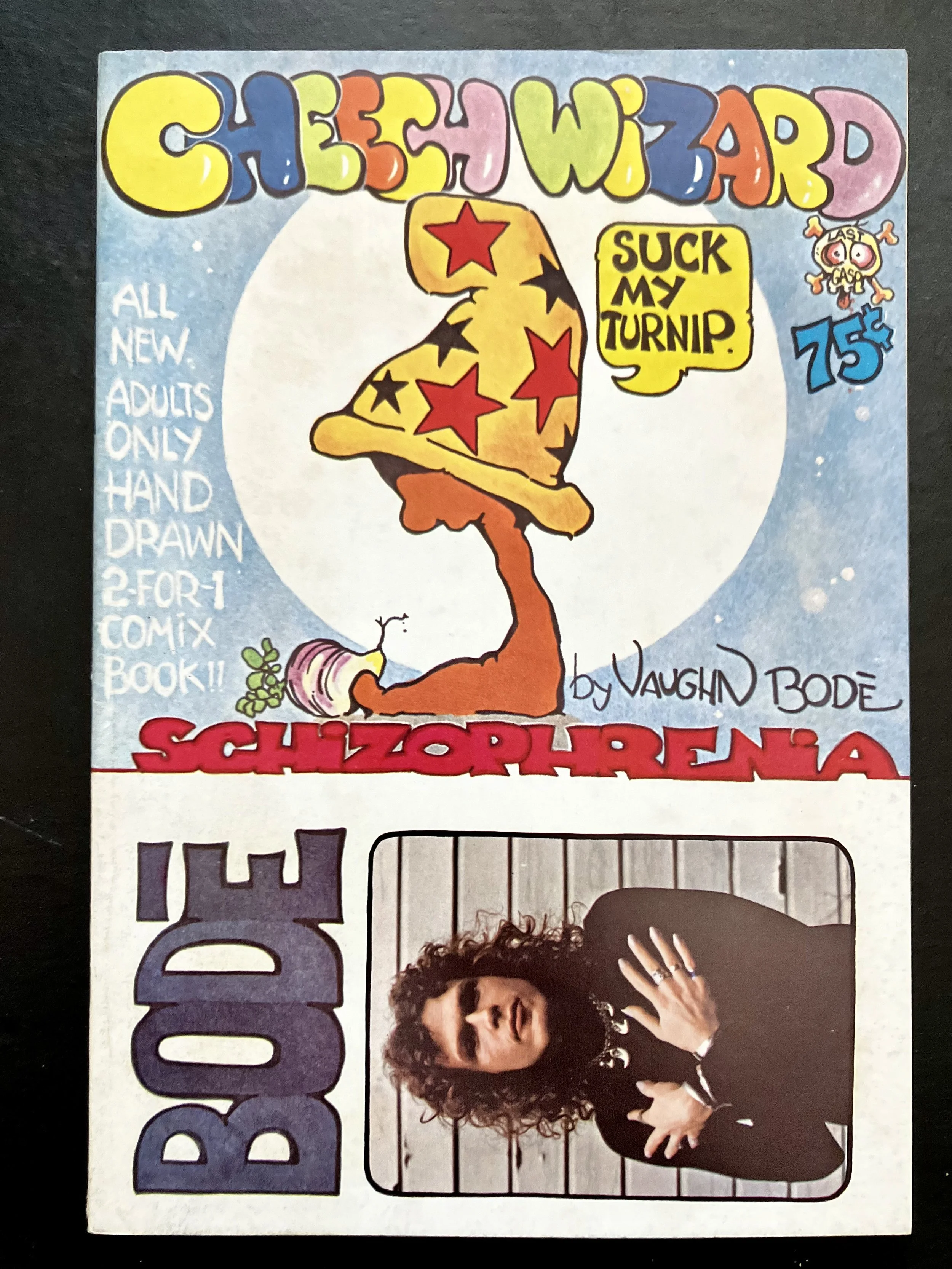
Adults Only! You must be over 18 to purchase.
Legendary underground comic published in 1973 by Last Gasp.
This book is really interesting because it is two comics in one. The top two-thirds of the covers and every page present short “comic strips” of Bode’s Cheech Wizard series. The bottom third, which runs sideways, is a comic story called Bode and represents a personal statement by the cartoonist, including their gender identity development. Arguably one of the first significant comic art statements around transgender identity.
Both stories are highly sexual in nature, as was most of this cartoonist’s work. Very cool art - they had a singular style that was polished and all their own.
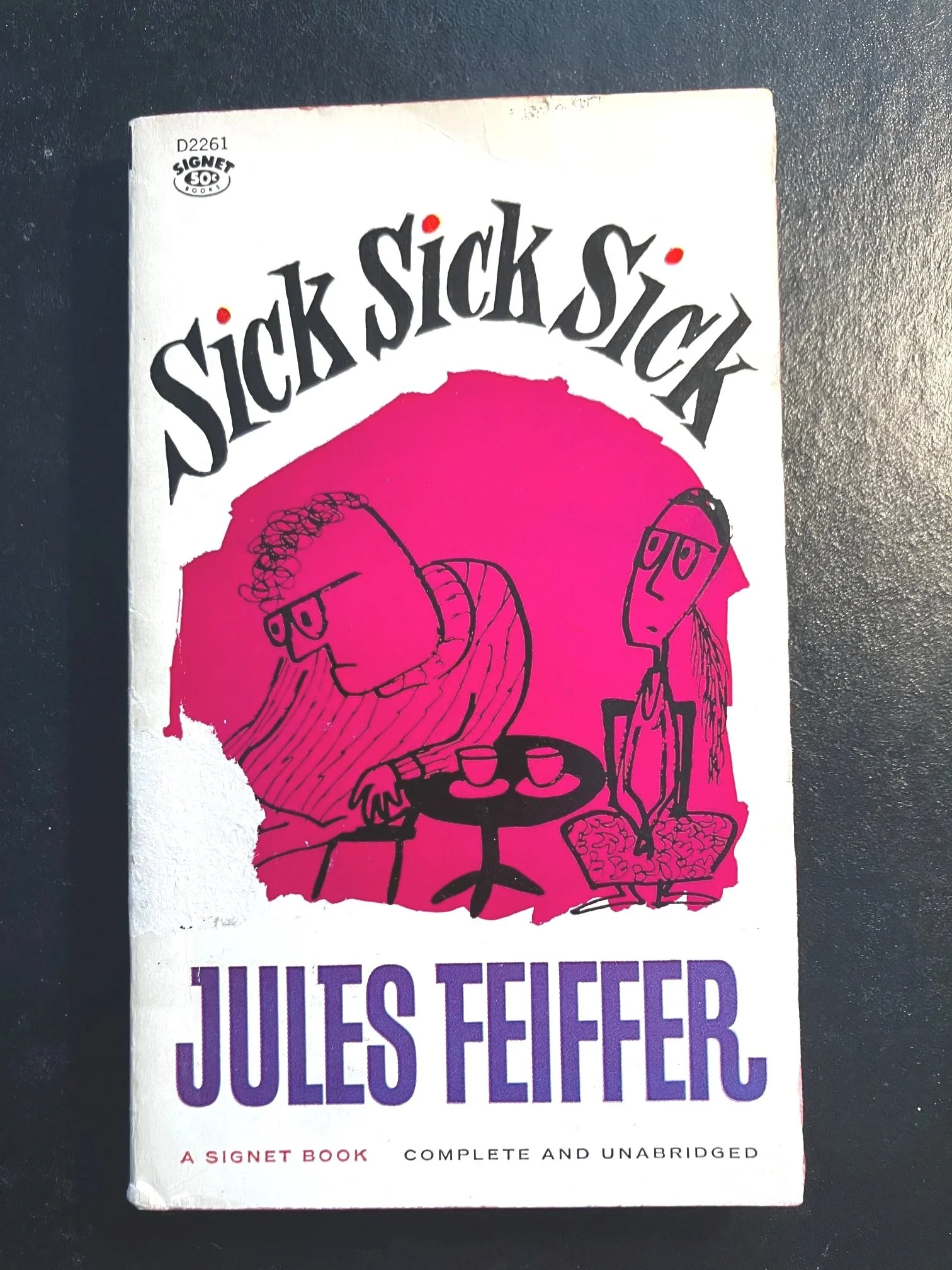
The first collection of Feiffer’s groundbreaking Village Voice cartoons and some of his best work. This edition shows wear but is complete and unmarked.
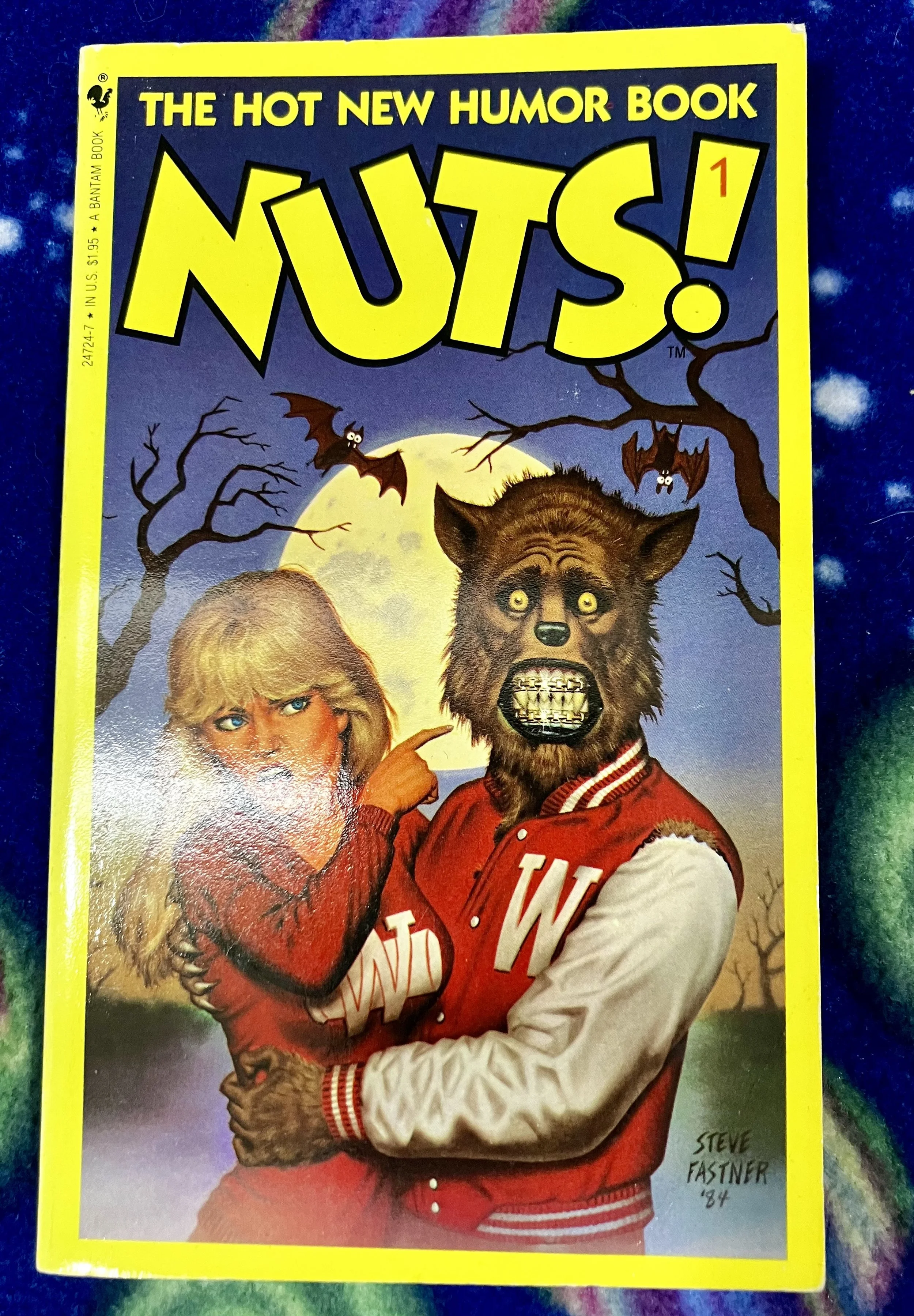
Byron Preiss was a book packager who loved comics and pulp science fiction. He put out some really interesting stuff - some of it in mass market paperback format. Check out his Weird Heroes series. I forget how it happened but I actually got to correspond with Byron shortly before he died in a traffic accident in 2005. Who knows how he managed to talk Harvey Kurtzman into a MAD-styled paperback series, but he did. Is it a magazine? Is it a book? Who knows? It’s NUTS! It lasted two issue-volumes.
While a pale shadow of MAD, NUTS! is still interesting for Kuzrtmaniacs like me. Collaborating with Sarah Downs, Kurtzman provides a clever book opener and three stories in this volume — all featuring two teen girls, Laurie and Versella. I love Harvey’s penwork on this. The book also has loads of other cool stuff, two Rick Geary stories, a Bob Fingerman story, a Ralph Reese MAD-like feature, and more. See the photos for the table of contents.
Condition
Like new, except for a blue harp stamp on endpaper (see photo).
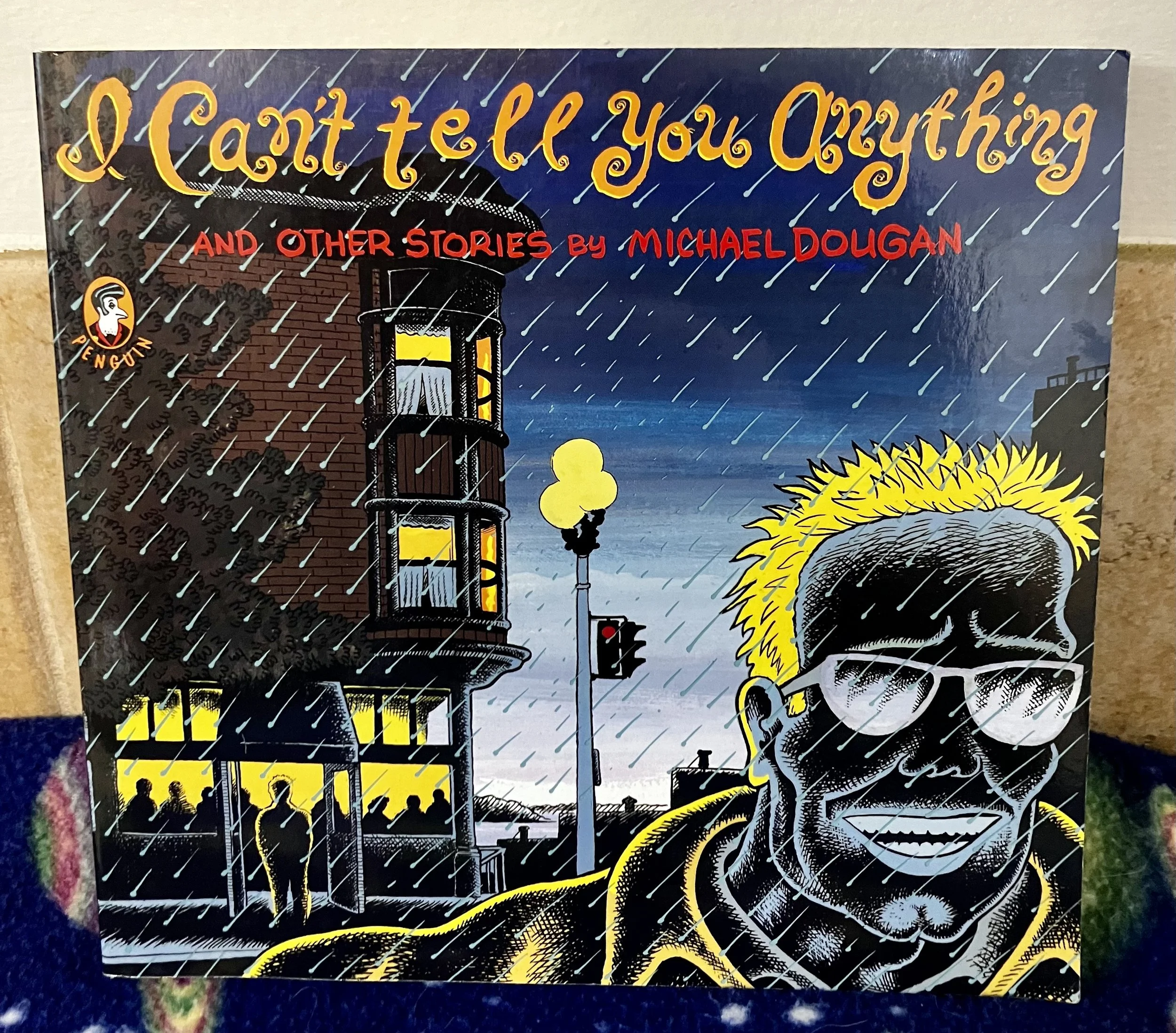
Thick, meaty brushstrokes and a rare ability to tell a truly funny story in comics form
If you don’t know this book and you like the Erratic Press sensibility, then chance are you’ll really enjoy this one. Dougan’s true-life adventures in the deep south and Seattle, Washington mix with hilarious fictional short stories. Unforgettable true story about working at a Texas funeral home. The last story is a satire of the ups and downs of working in a thinly veiled Starbucks (remember, this was back in 1993) and buying into the whole self-improvement movement. Maybe it’s ‘cause I grew up in Louisiana and lived in Seattle that these stories are so much fun to read — but I suspect many others will dig them, too.
His earlier collection material, EAST TEXAS: TALES FROM BEHIND THE PINE CURTAIN (1988) is worth seeking out, too with spot-on depictions of the bleakly hilarious modern South. ("Things for teenagers to do in East Texas: Go the lake and get drunk, get pregnant...")
I had the great fortune to meet Michael once, at a 1997 comic shop party in the Fremont neighborhood of Seattle. Jim Woodring and Jason Lutes were there, but I was most excited to meet Michael. I was very familiar with his work. I read his stuff in Boston before I moved to Seattle. I regarded him back then as one of my favorite cartoonists, in part because he wrote about the South, which is where I'm from (and he nails it - "The bigger the hair the closer to God"). I saw him as one of the best of the 1990's alternative cartoonists -- the ones who told funny stories about their lives. At the party, the one time I met him, he was very grounded and humble -- just a regular, real guy - very pleasant and a good talker. I still have my copy of ZERO ZERO #17, which he signed for me (he got the cover story in that one). We corresponded through email for a while and he patiently answered my gushing fanboy missives with grace and honesty.
He was such a nice, grounded guy - very approachable and modest.
You can read more about Michael Dougan here.

"I'm proud to say I knew the man who wrote this book. It is pure writing, never pretentious or forced, never melodramatic, but honest storytelling of the highest order. This is how to do it, if anyone wants to know: how to write simple prose from a young boy's point of view and hold the reader spellbound." - Elmore Leonard
Charles Willeford knew how to tell a story and he knew how to write. His Hoke Mosley crime novels set in Miami are some of the most vivid novels in my memory. As is The Shark Infested Custard, another Florida novel. Or, The Burnt Orange Heresy — a crime novel that explores art, morality, and commerce like nothing else I’ve ever read. The list goes on. Suffice it say, in my opinion, Willeford is one of the most interesting writers I’ve ever read. If you like Bukowski, Willeford has a similar world-view, sense of humor, and matter-of-fact style.
This book is non-fiction. Autobiography, to be exact. Written in first-person using a deceptively friendly conversational style, Willeford relates the story of his childhood and adolescence as an orphan. He moves from railroad yards to hobo tent cities, to soup kitchens and deserts around Los Angeles and across the United States. The ensuing tale is at once a picaresque adventure through Depression-era America and a portrait of the writer as a young man of seemingly little promise but great spirit.
This copy was sent to me by his widow, Betsy some 30 years ago. I happened to put up a copy of a rare Willeford paperback on eBay and she bought it. When I saw the buyer’s name, I refused to take her money and sent it to her at my own expense, happy to have the chance to do something for her. She emailed me thanks and asked if there were any of Charles’s books I was missing, and I named this one and the Shark Infested Custard. A week later, a generous package arrived from her with the two books, plus a copy of the privately printed, low print run A Guide for the Undehemorrhoided - worth hundreds today.
I wrote her back to thank her and she said, simply, that she wanted to “share the love.”
I have this book in an edition that collects it with his follow-up book that tells of his days in the Army. This trade paper edition, published in Britain in 1991, is much nicer. It is proportionate, fits well in the hands, is typeset well, and has a great cover. The photos of Charles and his family are printed larger and significantly more clarity than in the collected edition. For this reason, this is the most sought after edition of this book, which has been reprinted several times and, in fact, is currently in print for about $20. As of this listing, there are two copies for sale on AbeBooks; one for $125, and the other for ten times that amount.
In very good condition. Crease on front cover - barely visible on outside (see photos).
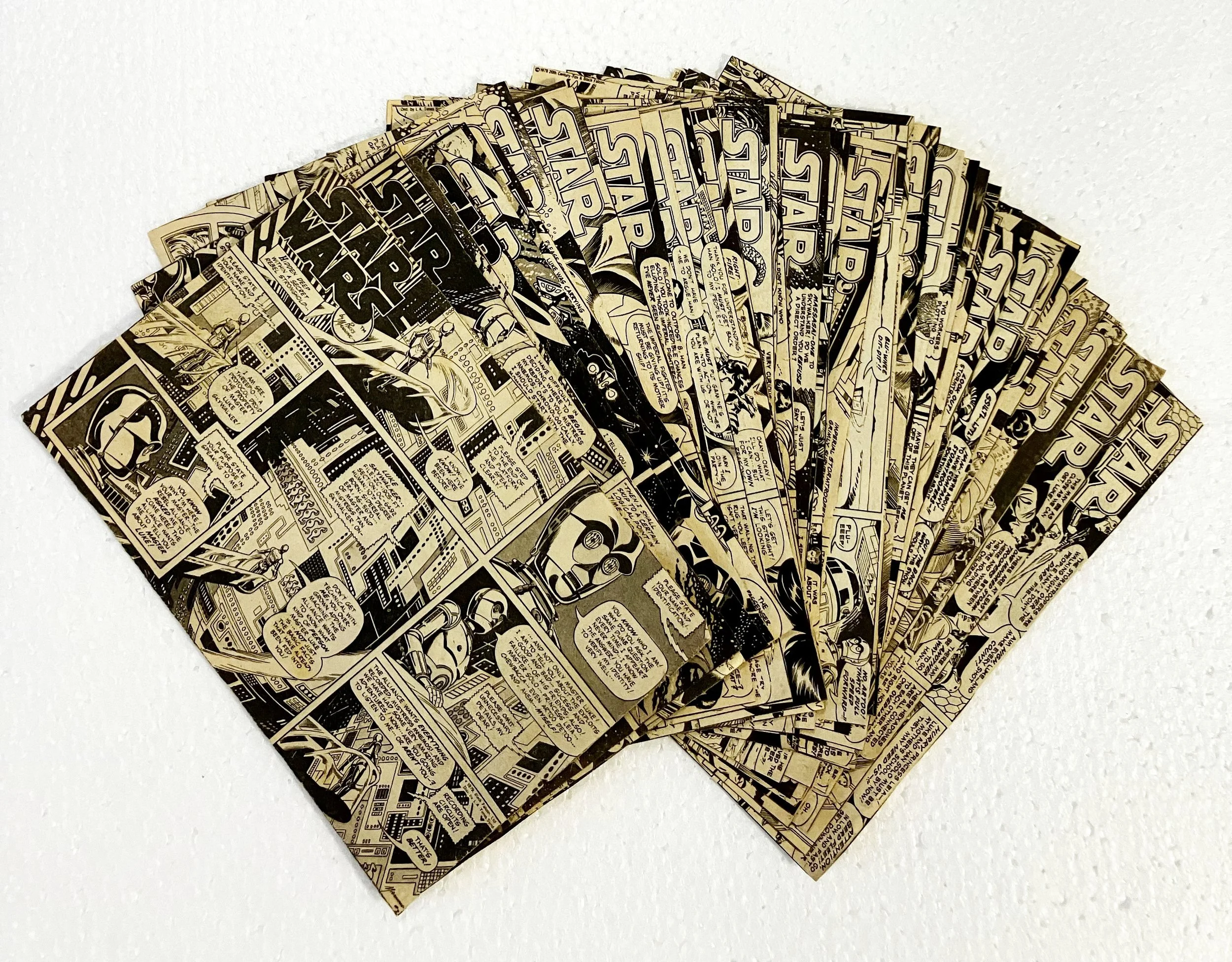
Complete run of the first Star Wars Sunday newspaper comic strips, as originally published in GRIT magazine, 1978–1979.
Russ Manning art (Magnus, Robot Fighter)
These are smaller black and white versions of the color Sunday pages more commonly available. Not often seen on the market.
This lot includes all 59 strips from the opening sequence of the series, featuring classic storytelling and great science fiction art by Russ Manning (Magnus, Robot Fighter; Tarzan).
These strips adapt and expand the early Star Wars universe, starring Luke Skywalker, Princess Leia, Han Solo, C-3PO, R2-D2, and several original characters created specifically for the strip.
Details:
• Complete first sequence: 59 strips
• Publication: GRIT magazine (1978–79)
• Format: clipped original newspaper strips
• Size: approx. 5.5 x 8 inches each
• Condition: see photos (typical age toning consistent with newsprint)
A scarce and historically significant run—ideal for collectors of Star Wars ephemera, newspaper comics, or Russ Manning’s work.
In 1978, writer Archie Goodwin and artist Al Williamson proposed an adaptation of the original Star Wars film as a daily newspaper comic strip, producing 12 black-and-white samples, but the team ended up not being available to produce the full strip. By the next year, writer and artist Russ Manning was hired to produce both a daily and Sunday strip spun off from the film. These originally told separate stories, which according to Manning were largely made up as he went along. After six months, he was replaced as writer, reportedly because newspapers wanted a story that was "more like a comic book". Subsequently, the daily and Sunday strips no longer told separate stories. Manning left the strip in mid-1980 due to his declining health; he died due to cancer the next year.
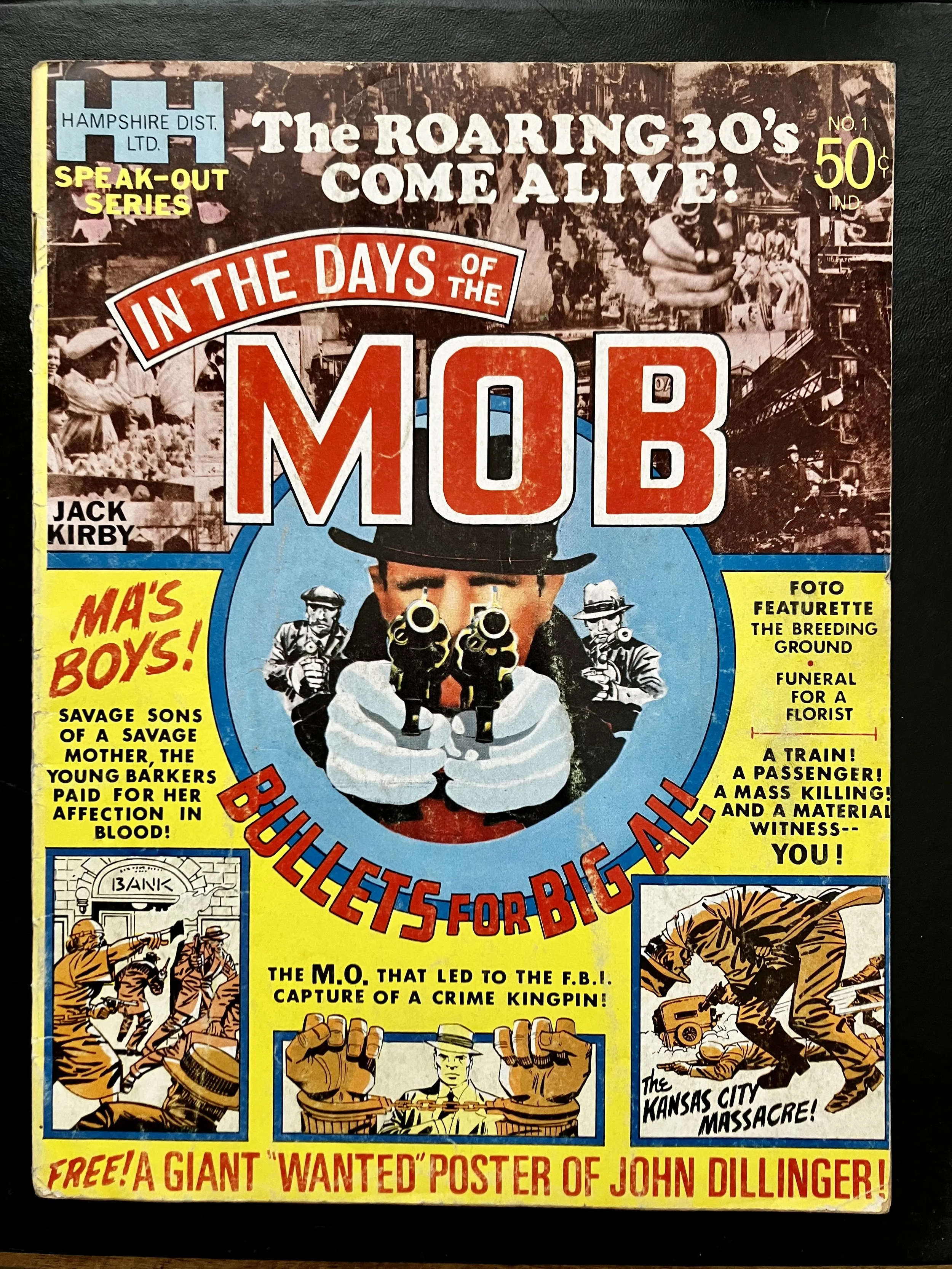
The Roaring Thirties! A unique, brilliant and little-known Kirby creation!
In 1971, Jack Kirby was in transition, moving from Marvel to DC. In the previous ten years or so, he had been the major force in reviving the costumed superhero in comic books. He was getting ready to go to DC and create the Fourth World saga as well as a bunch of other new characters. But in this transitional phase, he did a few magazines for Hampshire Distributing, Limited. This is one of them. In The Days of the Mob revives the gangster stories Kirby had drawn in the 1940s for titles like Headline Comics.
The first story starts with Warden Fry (1) saying to you, the reader, “Welcome to Hell!” The book just gets more and more intense from there. Included are mind-bendingly violent stories about Ma Barker and Al Capone. The centerspread is a classic Kirby double-page action scene. The art is ably inked by Vince Colletta, who does a great job of clarifying while keeping Kirby’s dynamic energy.
Most significantly, Kirby didn’t just draw these stories — he wrote them, signaling his new approach to comics in the 1970s, as a writer-penciller.
This copy has the foldout poster missing. Shows significant wear and tear with no markings or tears. See photos. This issue was reprinted an a $40 hardcover edition but — for some reason I can’t figure — the art for this issue was reproduced in sepia instead of black, sapping it of much of it’s visual presence. The book also contains the stories for the unpublished second issue - and these are in black.
For more information, see this essay by Harry Mendryk at the Jack Kirby Museum website and this YouTube episode of Cartoon Kayfabe with Jim Rugg and the late Ed Piskor, dedicated to this magazine.
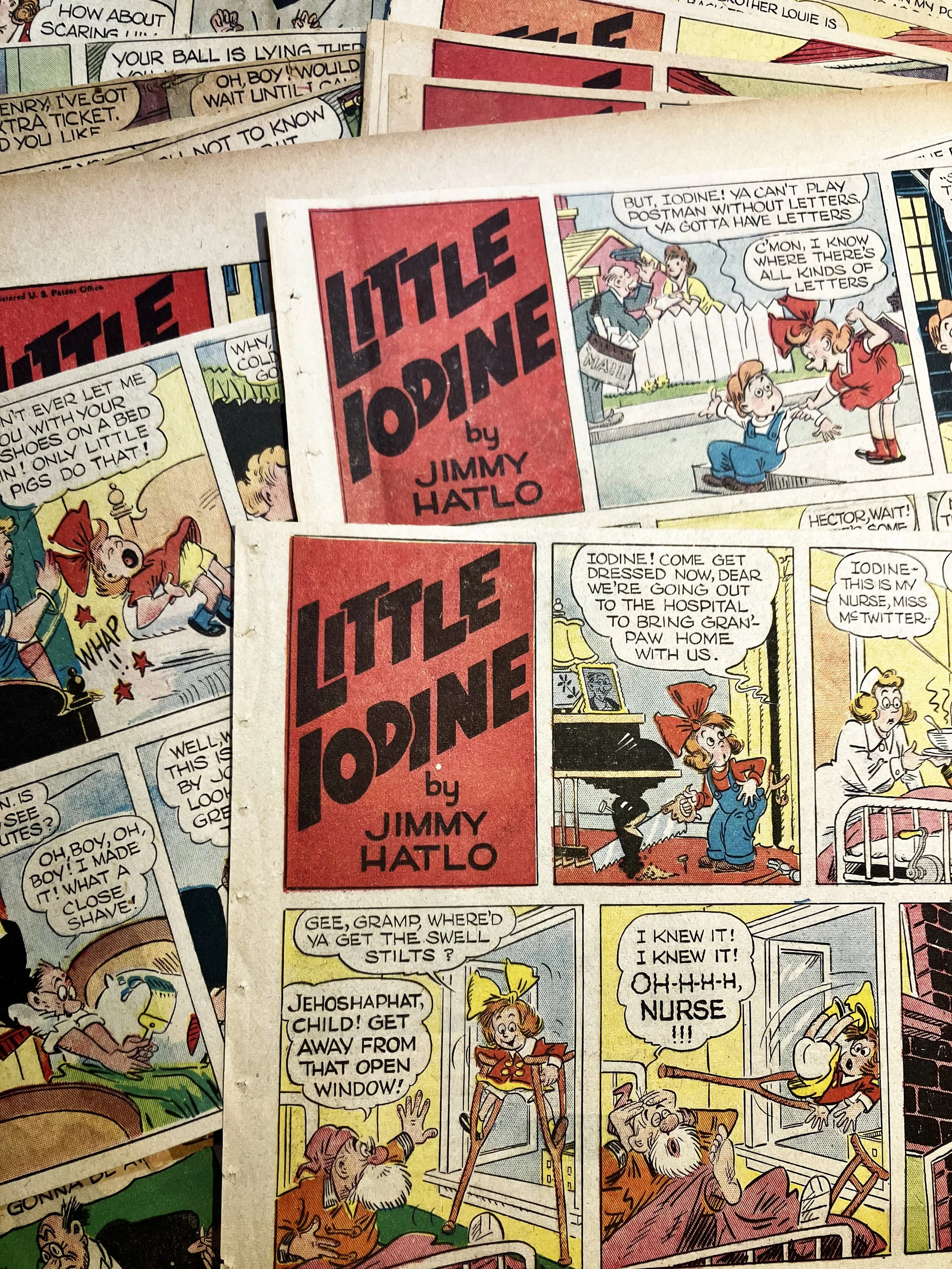
Little Iodine by the great Jimmy Hatlo!
Iodine is perhaps the most wicked kid in the funnies B.C. (Before Calvin). Personally, I find these comics hilarious - Hatlo was out there! Check out the close up in the photos section of the fist panel of a strip in which Iodine is happily sawing the leg off a piano - and this is before the little terror gets into real trouble!
12 halves, 36 thirds from 1944 to 1949. Shipped flat and well-packed from non-smoking home.
Dates are (h = half-page, otherwise a third):
1944
1-23
1-30
2-20
2-27
3-5
3-12
4-2
4-9
4-16
4-23
4-30
5-14
6-4
7-9
10-29
11-5
11-12
11-19
11-26
12-3
12-10
12-24
1945
5-13
7-29
8-5
9-23
11-25
1946
1-6
2-3
2-10
2-17
3-10
5-5
9-1
4-6
10-13 h
10-27 h
12-1 h
12-8 h
1947
4-13 h
5-4 h
10-5 h
11-23 h
12-7 h
1948
2-1
2-8 h
3-7 h
1949
1-30 h
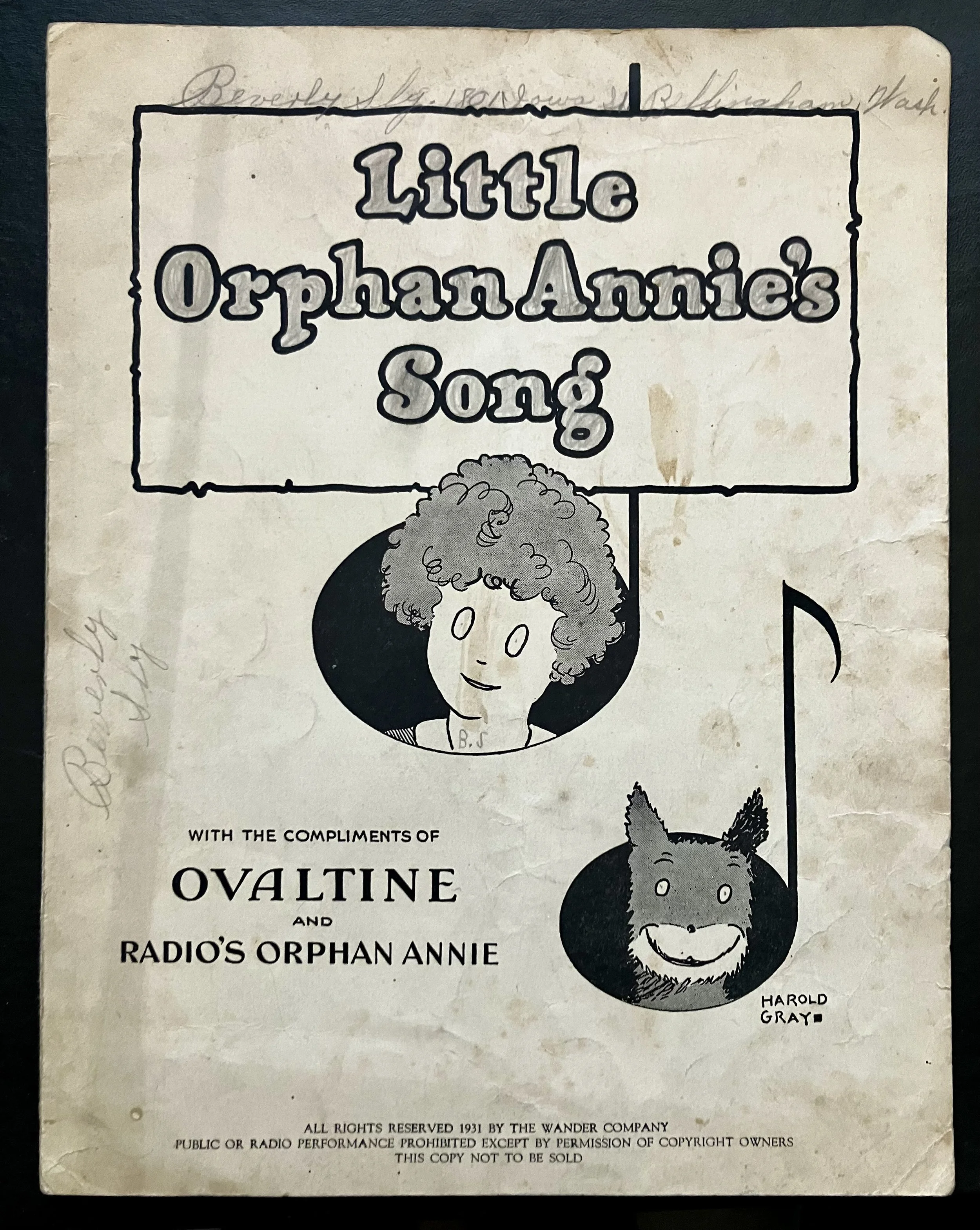
Own a classic piece of comic strip Americana - with a cover art by Harold Gray
This sheet music was a promotional giveaway by Ovaltine, the sponsor of the Little Orphan Annie radio program. If you’ve ever seen the classic Christmas movie, A Christmas Story, then you may recall the scene in which Ralph listens to the program to get the secret coded message, which turns out to be an ad for Ovaltine! In case you are wondering, this was a malted milk type product that supposedly had vitamins and nutrients.
This sheet music is four pages. A previous owner has enhanced the cover with pencil shading on the title.
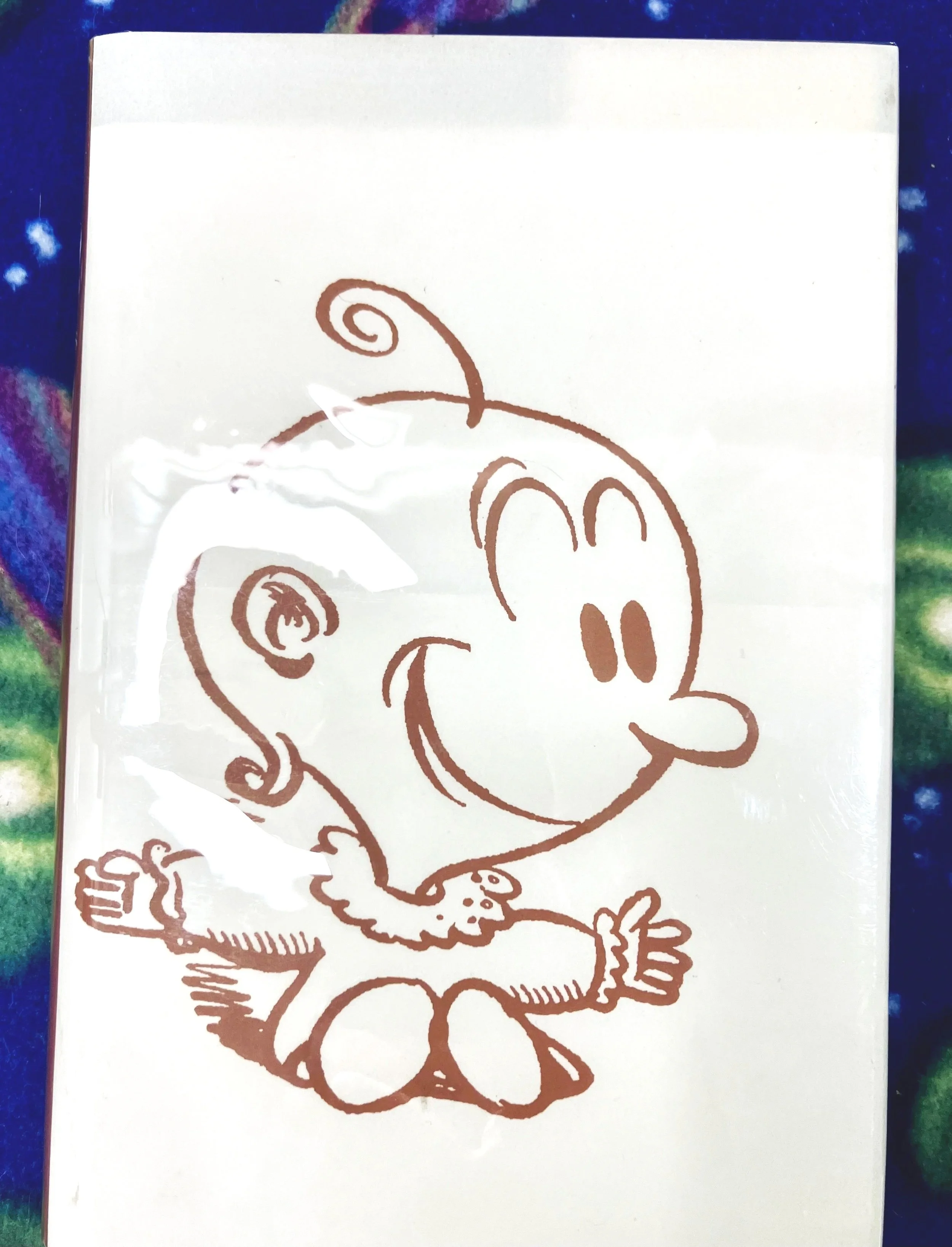
No Milt Gross collection should be without this book, worth it for the long, insightful, scholarly introductory essay alone - but stuffed with great, um, stuff (mostly Milt’s prose but also lotsa cartoons). An exceptionally clean, like new copy, HC with DJ in mylar sleeve. The original edition, with the Nize Baby on the cover in all his goofy, charming glory!
Introduced by an historical essay, Is Diss a System? presents some of the most outstanding and hilarious examples of Jewish dialect humor drawn from the five books Gross published between 1926 and 1928—Nize Baby, De Night in de Front from Chreesmas, Hiawatta, Dunt Esk, and Famous Fimmales—providing a fresh opportunity to look, read, and laugh at this nearly forgotten forefather of American Jewish humor.
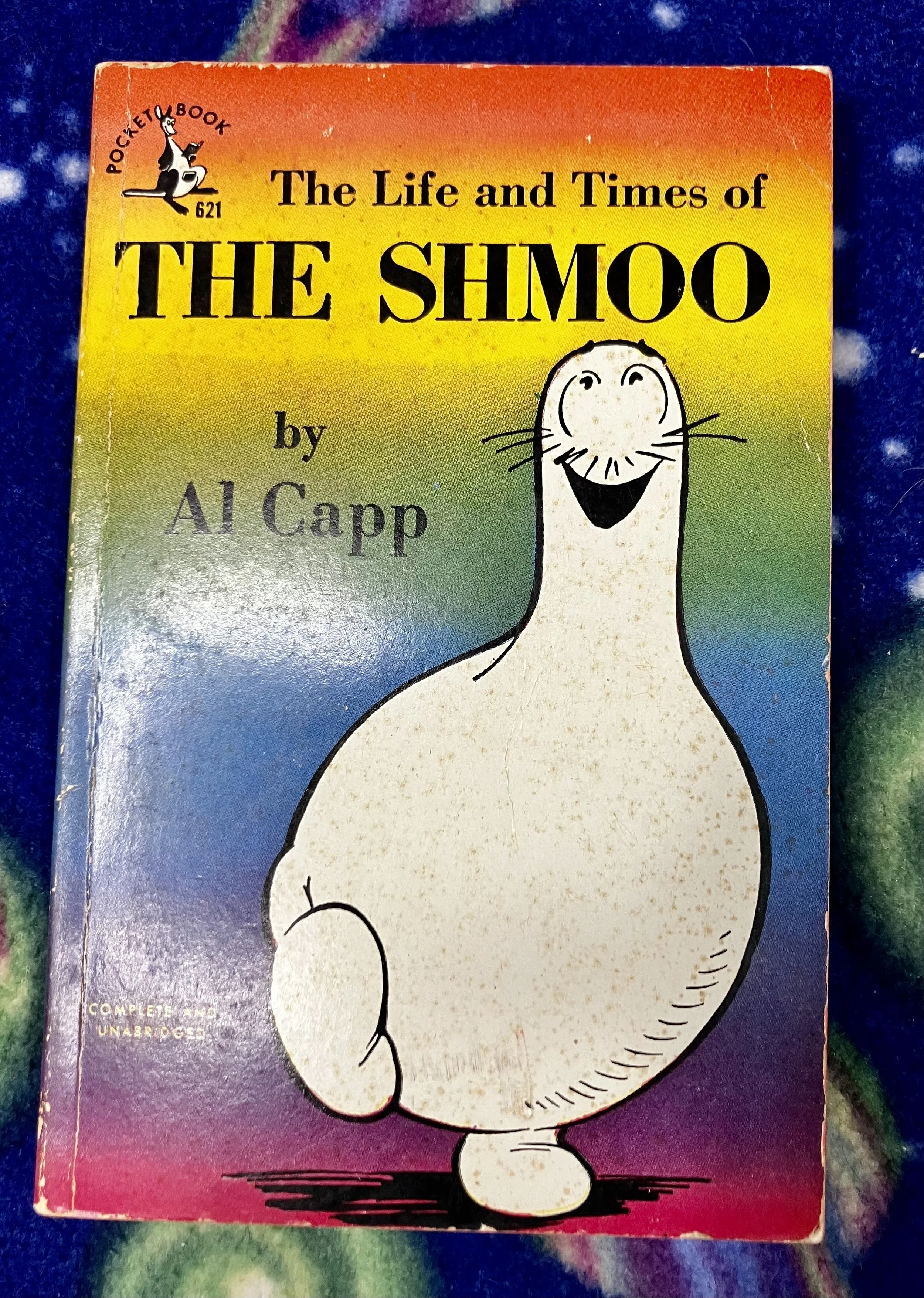
Here’s a unique vintage cartoon book - something more than a collection of reprints. It is thoughtfully — and artfully — arranged with sporadic commentary text by Capp (there’s even an appendix). Instead of white, the pages are colored red and blue.The shmoo (plural: shmoos, also shmoon) is a fictional cartoon creature created by Al Capp, which first appeared in the comic strip Li'l Abner on August 31, 1948.
Largely forgotten today, Capp had a way of hitting a nerve in Americans with his satirical comics.
In a 1949 Cosmopolitan interview, Cap explained:
“I was driving from New York City to my farm in New Hampshire. The top of my car was down, and on either side of me I could see the lush and lovely New England countryside... It was the good earth at its generous summertime best, offering gifts to all. And the thought that came to me was this: Here we have this great and good and generous thing—the Earth. It's eager to give us everything we need. All we have to do is just let it alone, just be happy with it.
Cartoonists don't think like people. They think in pictures. Little pictures that will fit into a comic strip. And so, in my mind, I reduced the Earth... down to the size of a small critter that would fit into the Li'l Abner strip—and it came out a Shmoo... I didn't have any message—except that it's good to be alive. The Shmoo didn't have any social significance; it is simply a juicy li'l critter that gives milk and lays eggs... When you look at one as though you'd like to eat it, it dies of sheer ecstasy. And if one really loves you, it'll lay you a cheesecake—although this is quite a strain on its li'l innards...
I thought it was a perfectly ordinary little story, but when it appeared in newspapers, all hell broke loose! Life, in an editorial, hailed the Shmoo as the very symbol and spirit of free enterprise. Time said I'd invented a new era of enlightened management-employee relationship, (they called it Capp-italism). The Daily Worker cussed me out as a Tool of the Bosses, and denounced the Shmoo as the Opium of the Masses...”
Condition
Minor creasing and some foxing on cover (see photos), complete, clean interior pages, a small name stamp appears on flyleaf and title page -otherwise unmarked.
Note
A previous edition by Simon and Shuster appeared in 1948. This is the Pocket Books edition - third printing (August, 1949)
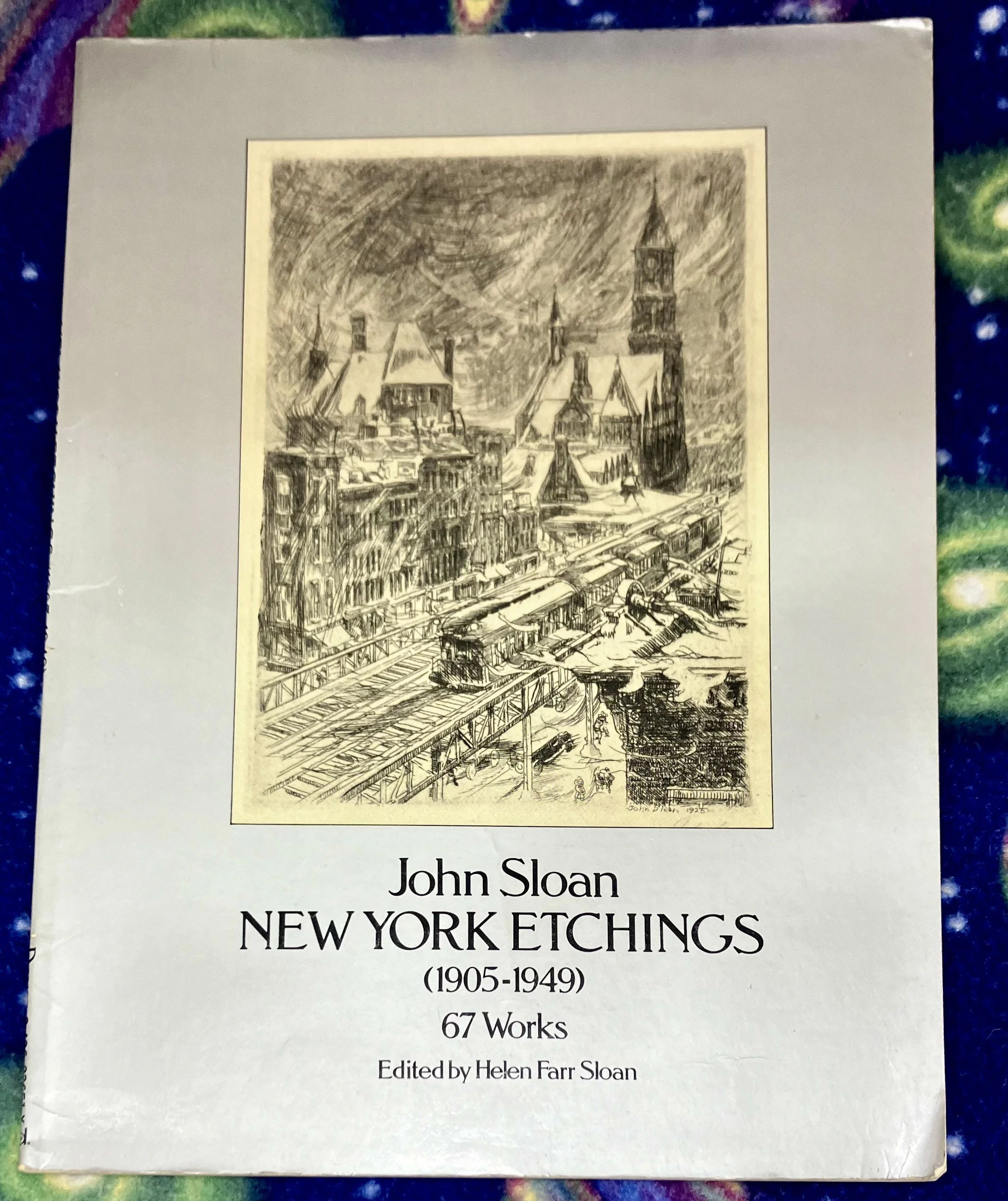
To me, Sloan’s New York etchings read like cartoons. They offer humanity observed by a good-natured, curious spectator with a seriously inspired artistic talent. New York was a huge city and Sloan drew upon its people and surroundings for inspiration. People sleeping on the roofs on hot nights. Beautiful, silly young girls in high spirits walking across Washington Square. A penny arcade, hanging clothes, rag pickers, reading in the subway. These images burst with life and good humor. The images are halfway representational and half cartoon sketches. Spanning from 1905 to 1949, this collection was lovingly assembled by Sloan’s widow, Helen Farr Sloan, who included Sloan’s own comments from interviews and his diaries. Sloan gives us a real sense of what it was like to be a New Yorker in these years.
Deets & Condition
Dover, 1978. 8.5 × 11 inches. 67 etchings. Minor wear on cover. Owner stamp on flyleaf. Foxing flyleaf and outside edges of pages. Complete, unmarked, binding sound, images are vividly clear (see photos). Printed on good paper - coated stock.
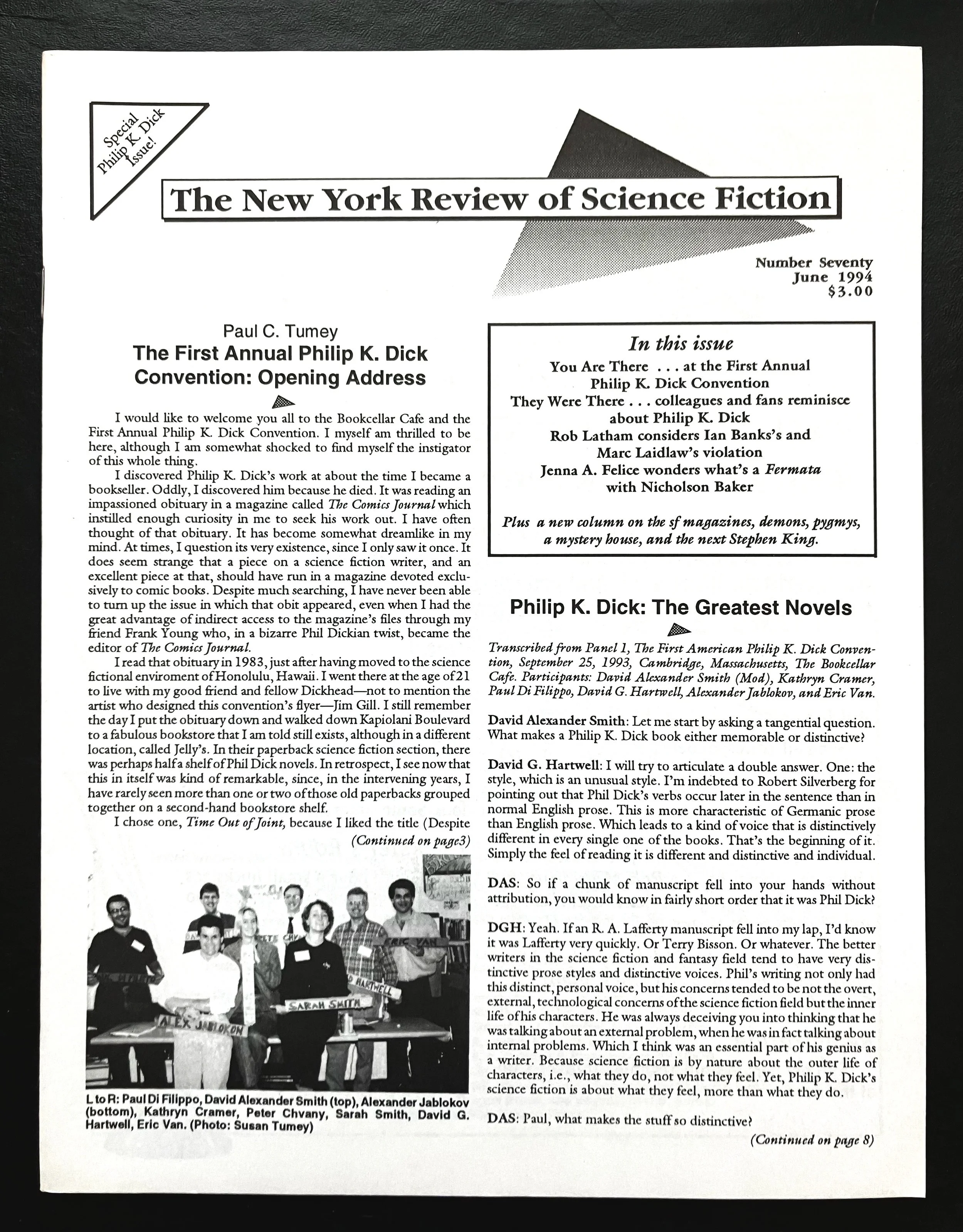
A PKD Rarity!
“He was always deceiving you into thinking that he was talking about an external problem, when he was in fact talking about internal problems.” - David Hartwell
This is issue #70 of David Hartwell and Co.’s New York Review of Science Fiction — the special Philip K. Dick issue from June, 1994
At this time, I was managing The Bookcellar Cafe in Boston. The cafe had two rooms - one was stuffed with old, antique books (I remember coming across a novel by Frederick Wertham one day!) and the other room was a performance space and gallery with tables. We held all sorts of events in that space, to draw people to the store. We hosted the first poetry slams in Boston (run by the folks who started them in Chicago), Scottish fiddlers on Sunday, Folk Music nights run by Elijah Wald (the recent Dylan biopic is based on one of his books), Storytelling with local legend Brother Blue and all sorts of one-off events, such as Richard Brautigan Day. I had the idea to hold the first American convention dedicated to Philip K. Dick, a writer who had grabbed my mind at the time and would not let go.
The event lasted all day, with several panels attended by numerous local science fiction writers. The special guest was David Hartwell, who had been Dick’s editor and had known him personally. About 15 or 20 attendees showed up and, to my amazement, stayed through the whole event. I remember, during the lunch break (we provided pizza for everyone) David came up to me while I was working the cash register and said, while munching on a slice of pepperoni pizza, that Philip would have loved this event.
I had promised attendees some sort of print item with transcripts of the panels afterward. I was crazy. I had no time to make this. So I talked David into publishing it in his mag and provided that to the attendees. I was particularly proud that I talked David into running a few photos from the PKD Con - the first time his formerly text-only magazine had ever run any visuals at all.
This issue includes my opening address, the full transcription of the “Greatest Novels of PKD” panel, and “Memories and Visions” - a collection of pieces writers had provided to the Con about PKD, including Paul Di Filippo’s wonderful piece, ‘I Dreamed I Saw Phil Dick Last Night.”
You will receive a new, unread copy. Kipple for your conapt not included.
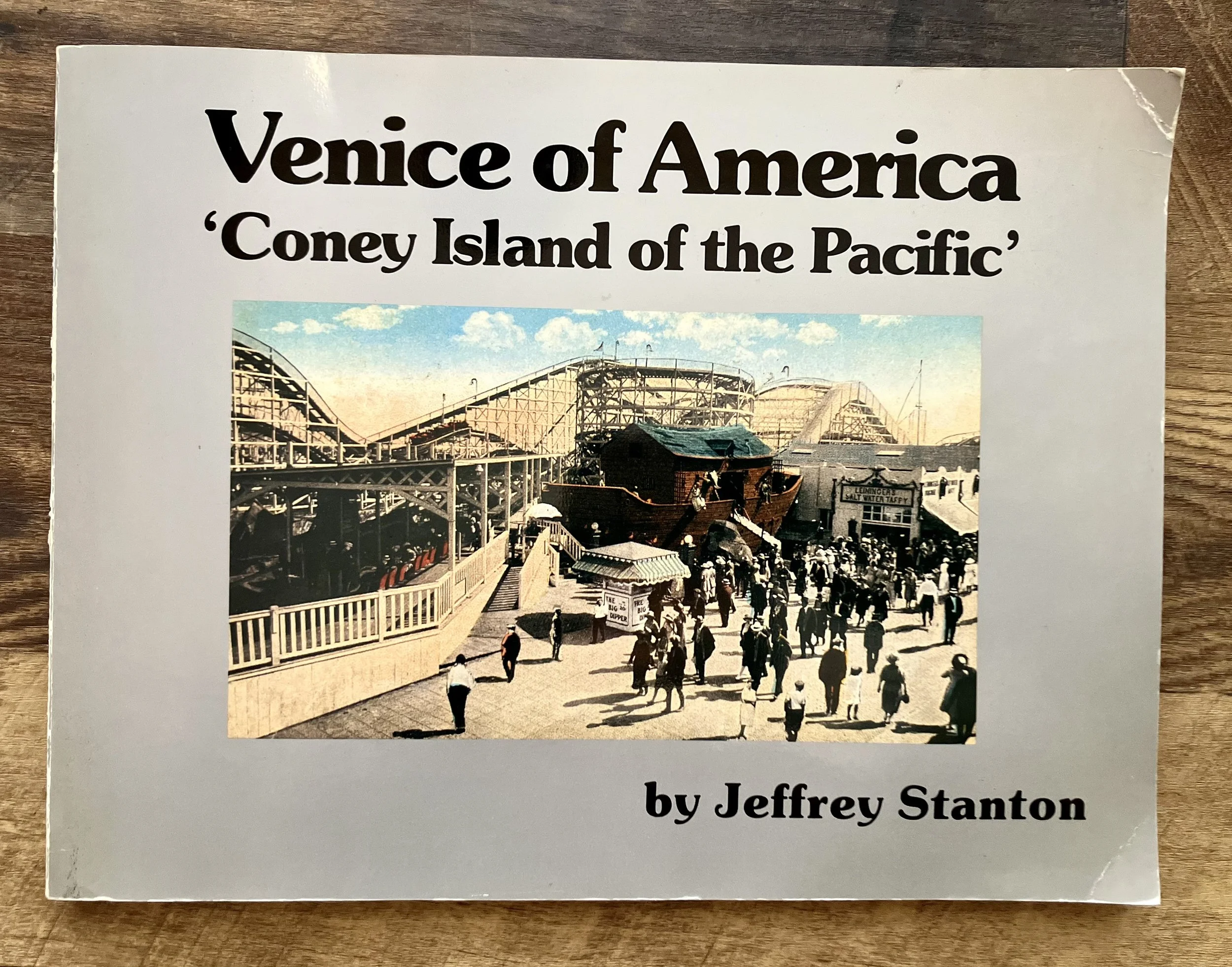
“The author was briefly our neighbor. He was an interesting, unique, outgoing and generous person. He gave us a copy of his book, and we treasure it. He was also a passholder for Disneyland and enjoyed going regularly. Definitely a character! He recently passed at 79 years old, not long after getting an award for his work on Venice history. We were so glad to read that he had finally been recognized for his work.” - Amazon Review
This is what I call an LOL Book (Labor of Love). Gobs of detailed information on California’s beachside pier amusement parks with jaw-droppingly cool photos. Large trade format lets you really study the details in these historic photographs. Learn all about the Some Kick Roller Coaster, the Toonerville Fun House (named after Fontaine Fox’s comic), the Felix the Cat game concession, One-Eyed Circus, the Flying Carpet, the Mirror Maze, Davy Jones Locker, the scandals, the politics, the people, the builders, and the colorful characters who ran the amusements.
Cover corners bent (see photo). Unmarked, complete, binding solid.
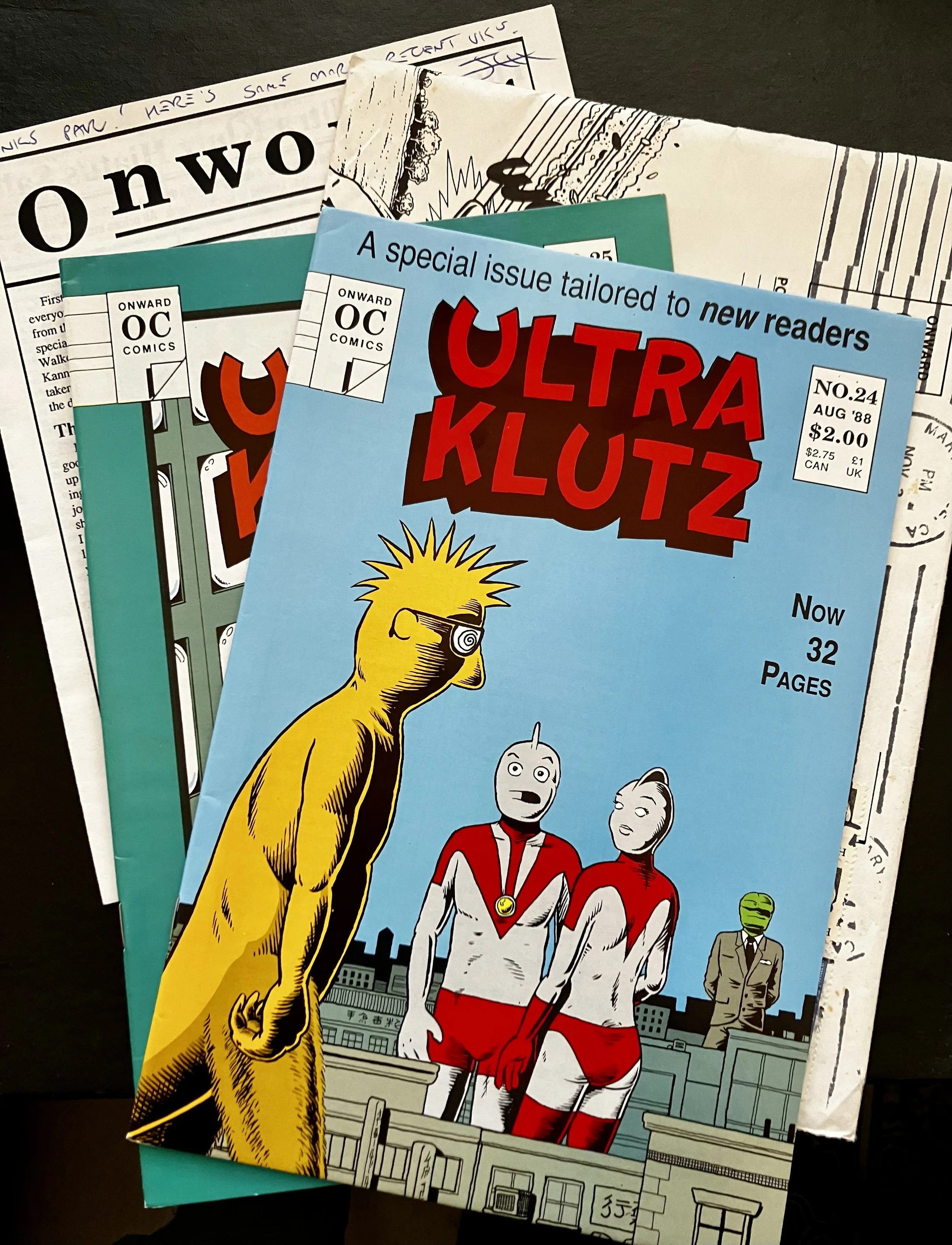
A DIY self-published standout series from the 1980s - totally original!
"ULTRA KLUTZ is dynamite! Funny, boisterous, thoroughly original."
-- Scott McCloud, UNDERSTANDING COMICS"
From creator Jeff Nicholson’s webpage:
“Ultra Klutz was my obsession during the 1980’s. Although the comic book series began as a torturous parody of Ultraman, it evolved into a complex interplanetary comedy soap opera that for the most part defies description. Always consistent was my unquenchable enthusiasm for the series and keeping the publication going, which was as much a part of the series as the story itself.”
I was a fringe contributor (as usual) to the 1980s boom of self-published comics and I traded with Jeff a few times. I was really impressed when he took his comic to the next level and got national distribution and professional-looking books!
Includes the original mailing envelope with canceled stamp and printed art, plus a signed copy of Nicholson’s newsletter.
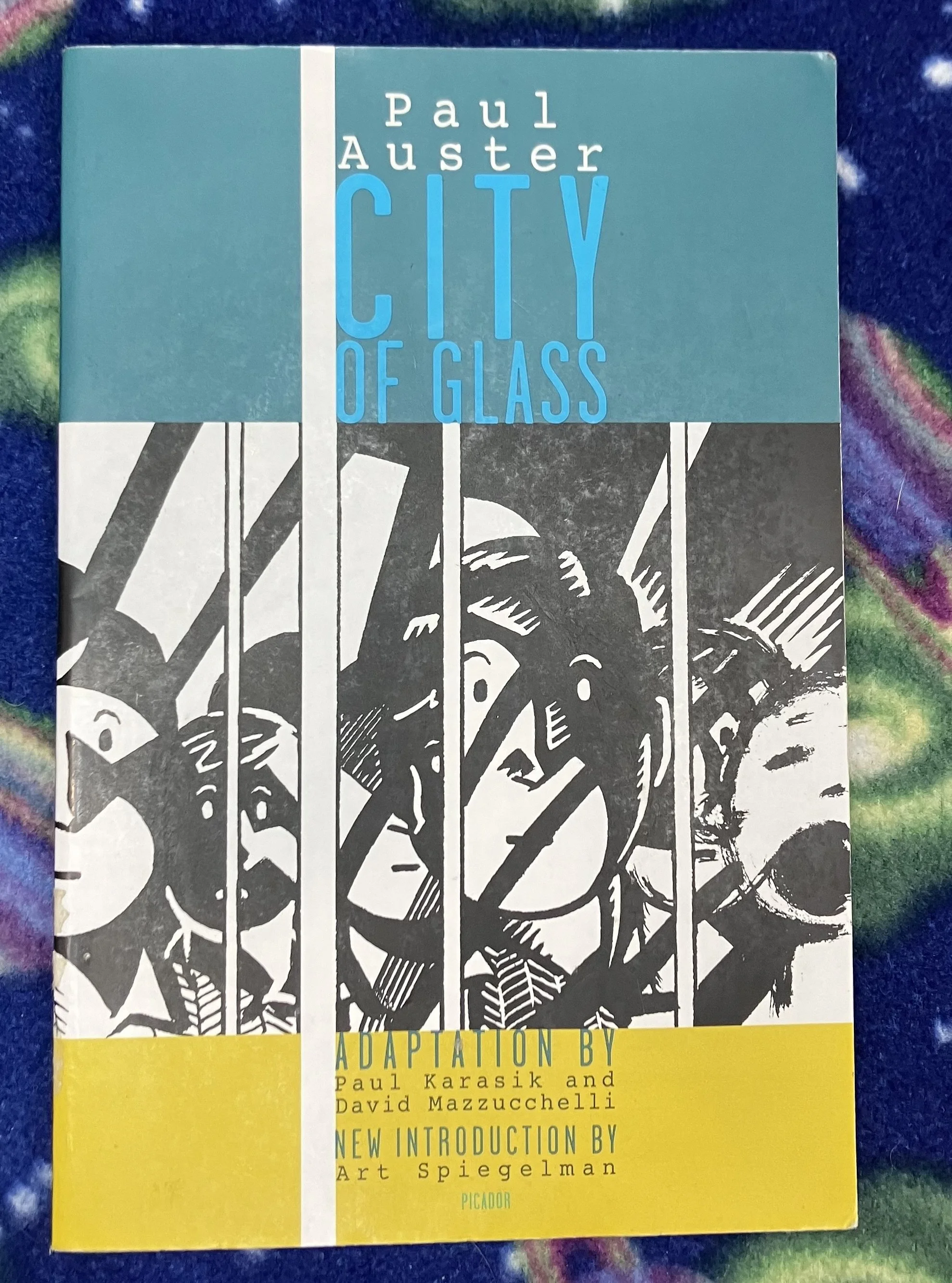
One of the best modern comic book adaptations of a literary work in English. Karasik did a magnificent job breaking the book down into a visual narrative. Mazzucchelli’s art is perfectly suited to this dark, brooding, existentialist mystery. This is the 2000 reissue, with a behind-the-scenes, informative, and trademark witty 3-page introduction by Art Spiegelman, the original editor/designer of the Neon Lit series of which this book was the flagship release.
Condition
Clean, unmarked, sound binding, shelfwear on cover, slight warping on bottom eighth of book first 50 pages. A reader’s copy.
Favorite Quote From Book
“To undo the fall of man, the fall of language must be undone.”
Honestly, if you haven’t read this one, you’re missing out.
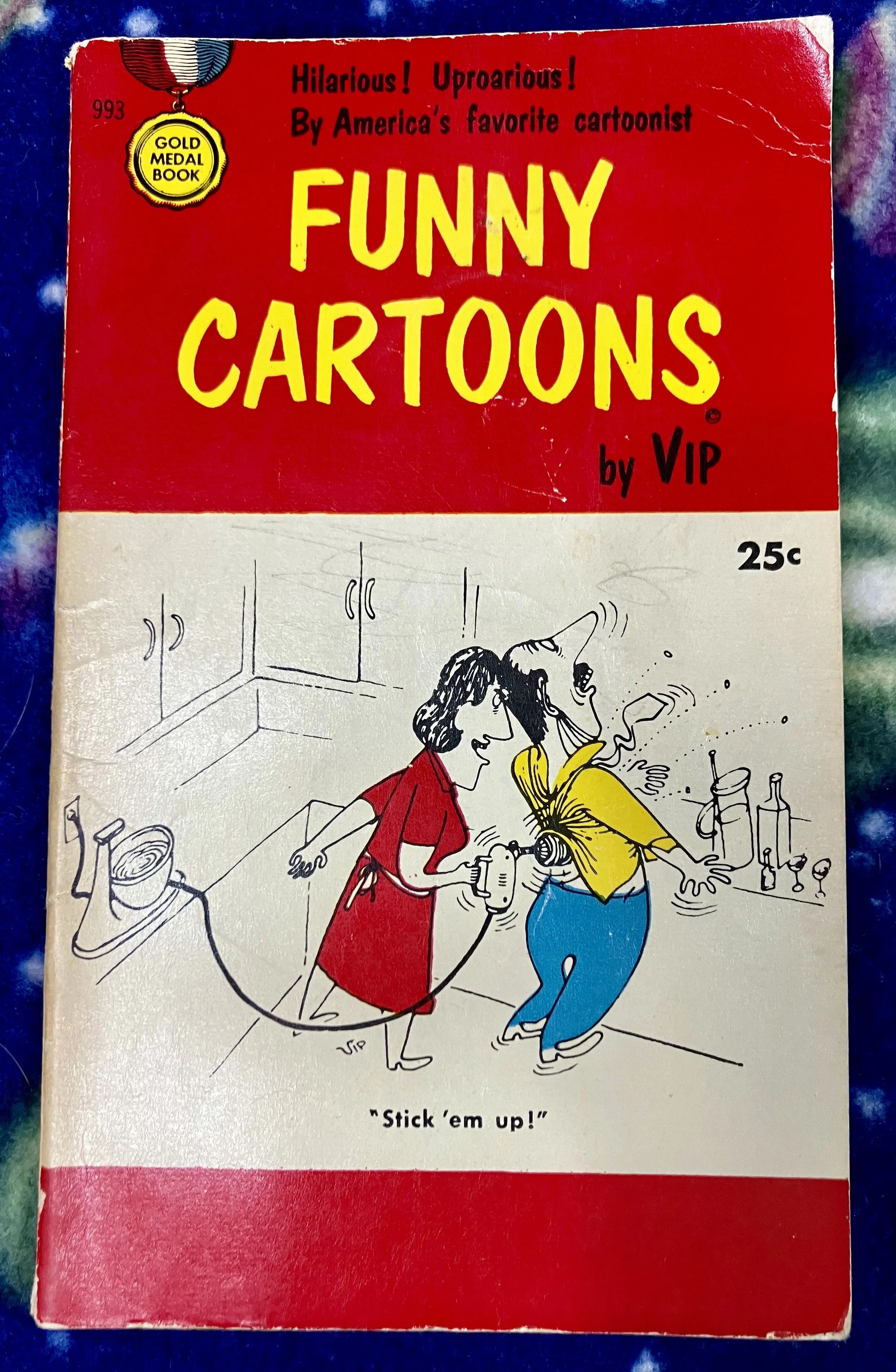
Sexually charged anarchist humor from 1950s America
Third printing, April 1960
This wonderful collection by the inimitable Vip (Virgil Partch) lives up the promise of its title - funny, indeed! 155 pages of Partch’s unique, off-the-wall, slightly off-color cartoons drawn in his singular style. Vip’s work is also special because of his subject matter, drinking, sex, hats, surrealism, and bathrooms. A rare find!
Condition
Average creasing and wear on cover and spine for a paperback of this vintage (please see photos), complete and unmarked.
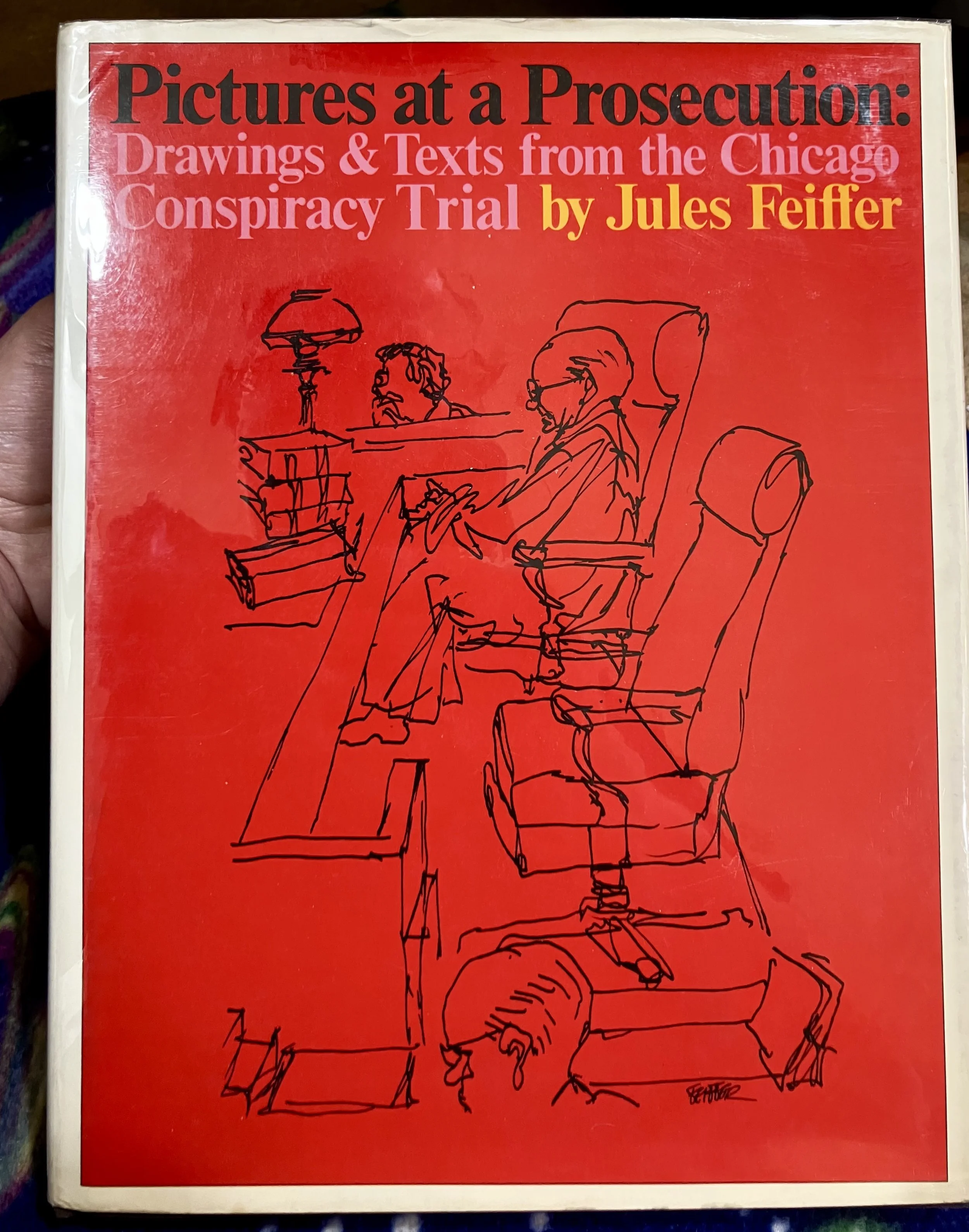
“Along with Tad Dorgan’s “Battle of the Century” prizefight cartoons, Art Young’s portraits of the Haymarket prisoners and especially Bill Mauldin’s extensive World War II work, Feiffer created some of the twentieth century’s most gripping comics journalism, paving the way for cartoonists like Joe Sacco, Sarah Glidden and Guy Deslisle.” - Michael Tisserand in The Comics Journal
In late 1969 and early 1970, Jules Feiffer made several visits to Judge Julius Hoffman’s courtroom during the prosecution of 1968 Democratic National Convention protesters Abbie Hoffman, Jerry Rubin, Rennie Davis, David Dellinger, John Froines, Tom Hayden, and Lee Weiner (and Bobby Seale until he received a mistrial). These men, known as The Chicago Seven (or Eight) had been arrested at the Democratic National Convention while peacefully - but effectively — protesting the United States’ involvement in the Vietnam War. Photos were not allowed. So, sitting in the spectator’s section, Feiffer made 250 drawings and used his talent to capture what would otherwise have been lost - eyewitness impressions. This remarkable book, created by Feiffer includes transcripts from the trial with his drawings. As Feiffer writes:
“ The purpose of this book is to give the reader a sense of what it was like to do time in Julius Hoffman’s courtroom between September 24, 1969 and February 18, 1970. Toward that end I have raided and rearranged sections of the transcript, lifted out of context, trifled with chronology, and put together what I hope amounts to a cinema veritie version of the conspiracy trial.”
Judge Hoffman was, to say the least, politically biased and unfair to the men on trial. At one point, Feiffer draws the Judge mocking reciting Seale’s word in blackface. Feiffer cynically and presciently goes on: “If in reading this the atmosphere of oppression becomes intolerable … you’re on your way to understanding what it was like to be there and what it’s going to be like at future political trials.”
Here’s you chance to own and study a landmark piece of comics journalism and perhaps the least-known of Feiffer’s many outstanding accomplishments.
Condition
Hardcover with dustjacket in mylar. Very minor wear on DJ, inside clean. Inscription on flyleaf (see photo). Pages otherwise unmarked and white. Binding sound,. Solid Good to Very Good.
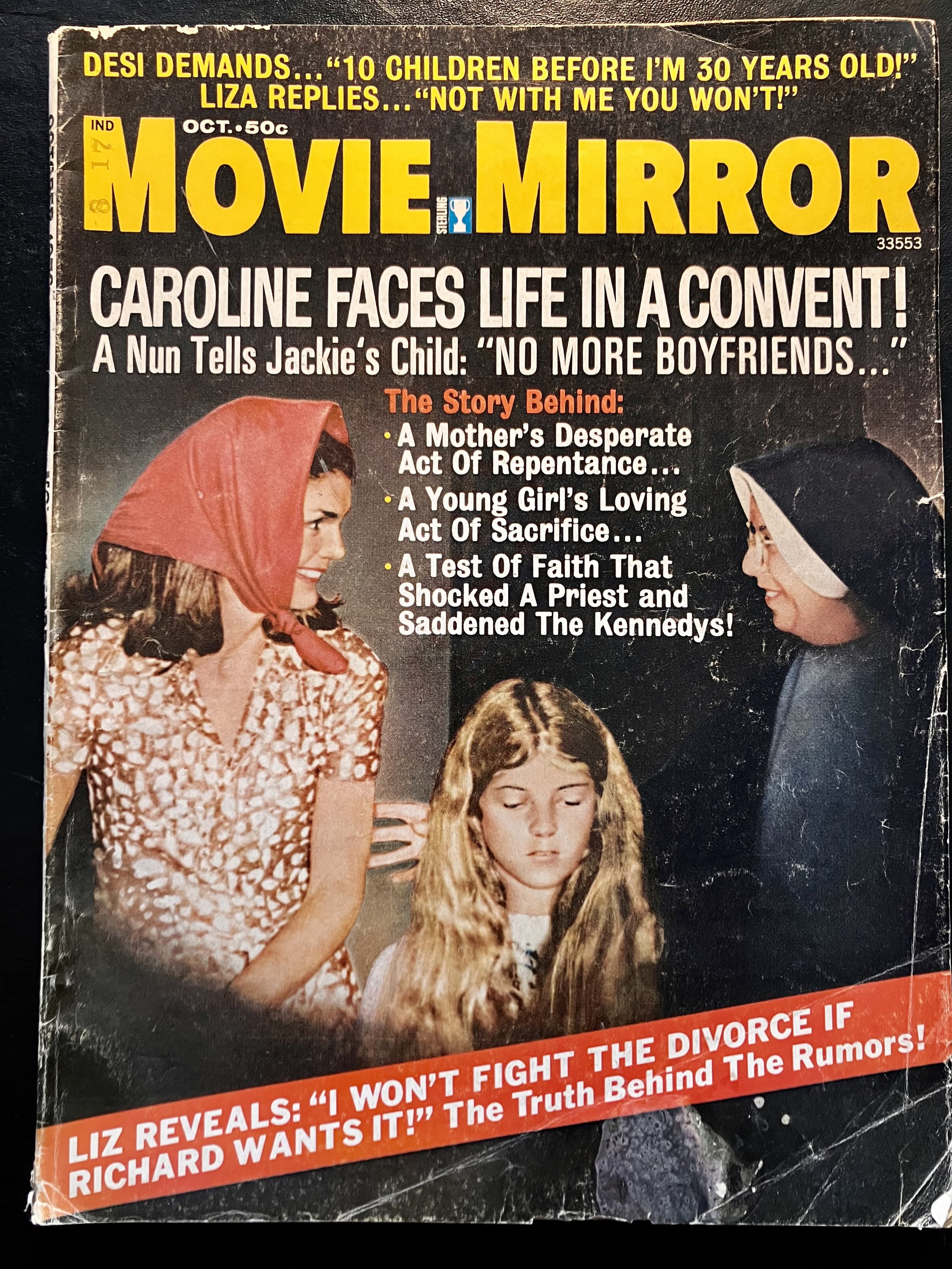
A classic example of 1970s tabloid gossip magazine aesthetic!
This thing has to be seen to be believed. Dirt is dished up on celebs of the early seventies, including Sally Struthers (All in the Family TV star), Caroline Kennedy, Dean Martin, Liza Minnelli, Lloyd Bridges, Connie Stevens, and even a spread suggesting Carol Burnett and other female stars cheating on their marriages with Jim Nabors (not widely known yet that he was gay).
More than the fictional content, the layouts and design are worth studying as effective ways to grab the eye - anticipates our current visually-dominant culture but with a severe trashy vibe. Liberal use of quotes, bold typography, crystal clear layouts, minimal text… everything is designed in service of the “have you heard…” vibe.
Great wig ads, too - which makes me think of the amazing cover art for The Rolling Stones album, Some Girls.
Creased and worn, just like a magazine like this from 1972 would be.
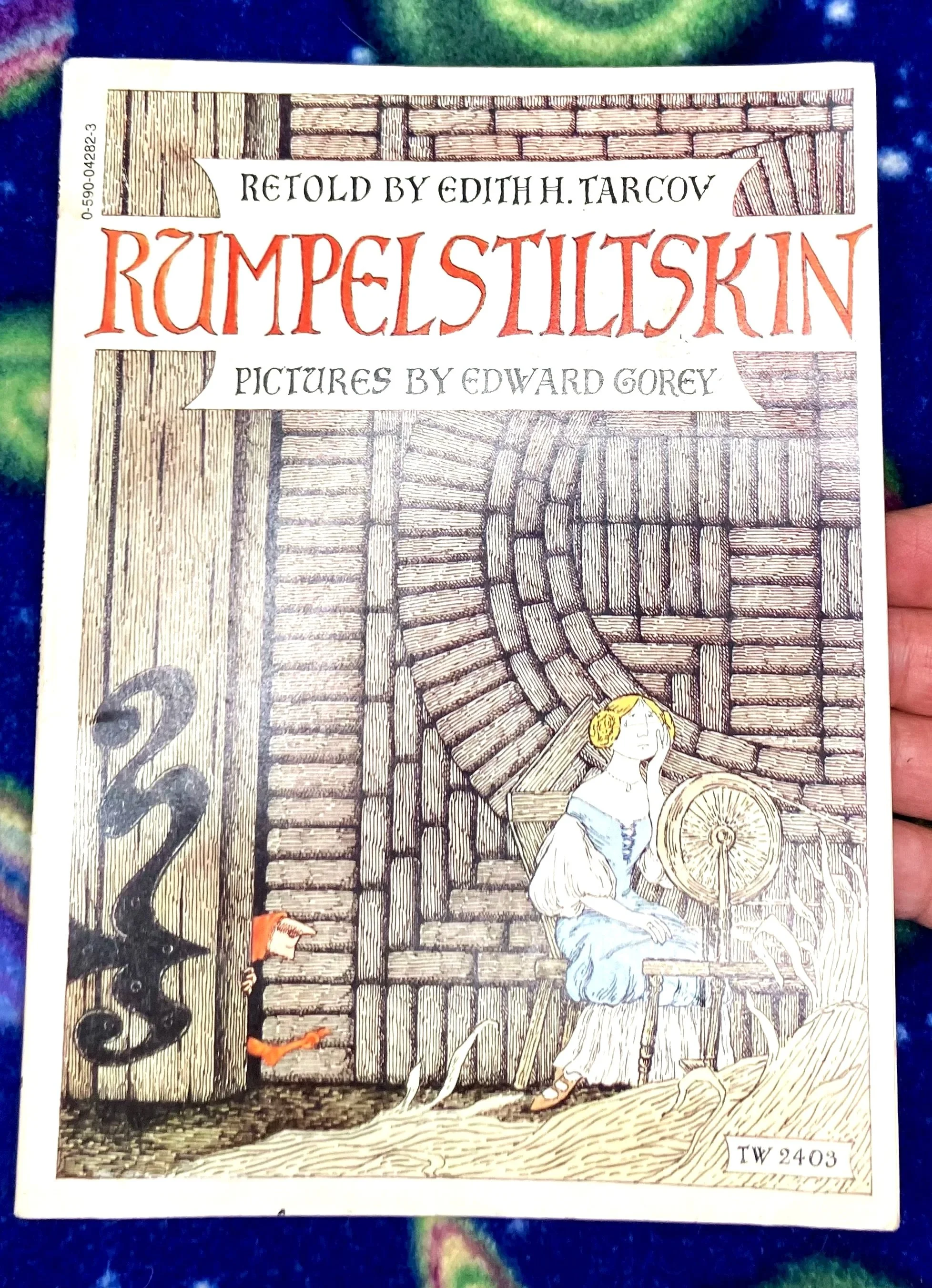
If you guess his name, your get to keep your baby. Believe it or not, this is a Scholastic children’s paperback version of the grim Grimm fairy tale. Gorey was the perfect artist for this project - and the book is filled with his sly, funny, and meticulous illustrations. Especially great is how the color yellow is used in the otherwise black-and-white art. Splendid concept when you think about this tale of pretending to spin straw into gold. Text by Edith H. Tarcov.
Condition
Fair to Good. Complete, no markings. A few small cover creases and slight soiling. Back cover has ink stain (on black art - see photo) which bled through slightly to the blank inside back cover (again, see photo).
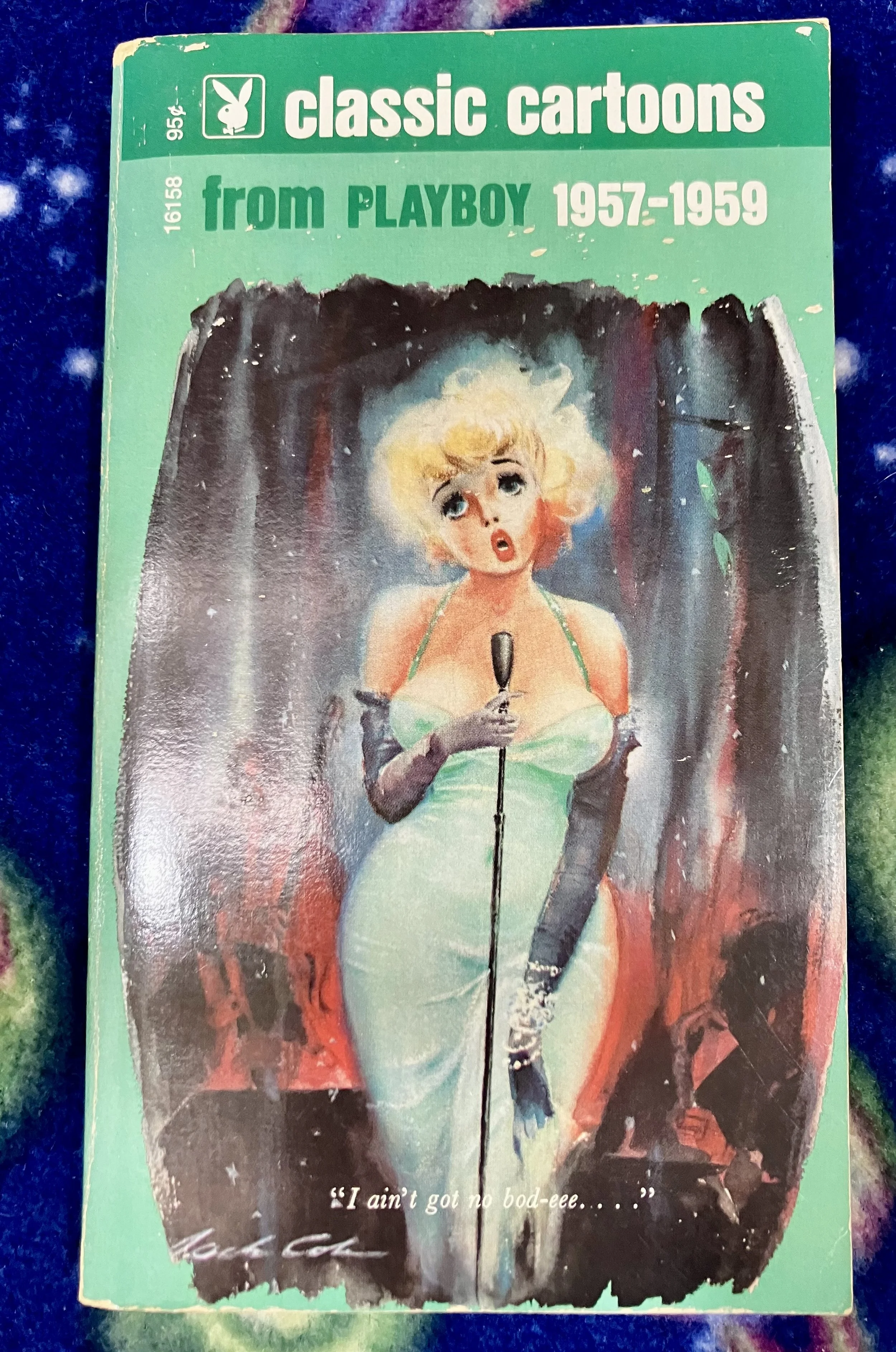
A wonderful color Jack Cole cartoon graces the cover of this paperback stuffed with great cartoons. The book includes 13 more Cole cartoons inside plus a special section of five of the famous “Females by Cole.” In Playboy’s early years, Cole became the upstart magazine’s signature cartoonist, arguably creating a the magazine’s sensibility for cartoons - sophisticated, adult humor, sexual, and beautifully drawn. Not every Playboy cartoonist could meet the standard Cole set, but several did in the early days, including Gahan Wilson, Jack Davis, John Dempsy, Erich Sokol, and Shel Silverstein - all of whom have work in this book.
Condition
Cover has shelfwear and finger indents, unmarked, no writing and complete.
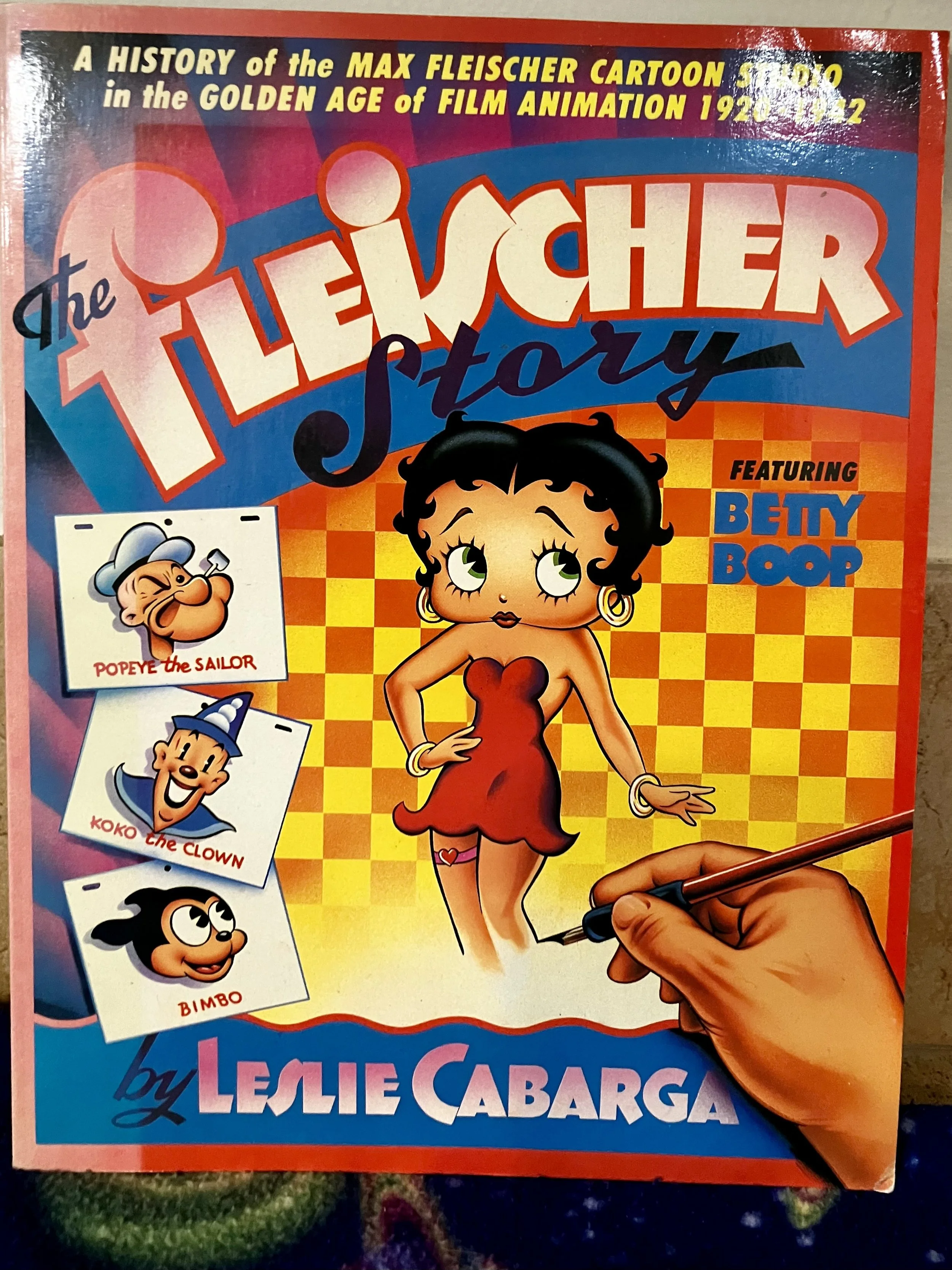
“A necessary book for anyone who loves cartoons” - Art Week
For fans of the Fleischer Brother’s Studio fantastic, weird, funny cartoons of the 1920s through 40s, this book delivers like few others with a well-researched and personably delivered history loaded with rare art and photos. Written and designed by graphic artist and cartoonist Leslie Carbaga (who appears to have based his style at times on Fleisher Studios art - he did the wonderful cover of this fine volume, for example). From the creation of Betty Boop to the Popeye and Superman cartoons and beyond, there is just so much fascinating stuff in her, I can’t recommend this book enough to fans of this material.
Deets & Condition
217 pages. Trade Paper 8.5 × 11 inches. Black and white interior, color covers. In Good condition with some minor creasing on cover corners. Clean copy, unmarked and complete.